The book
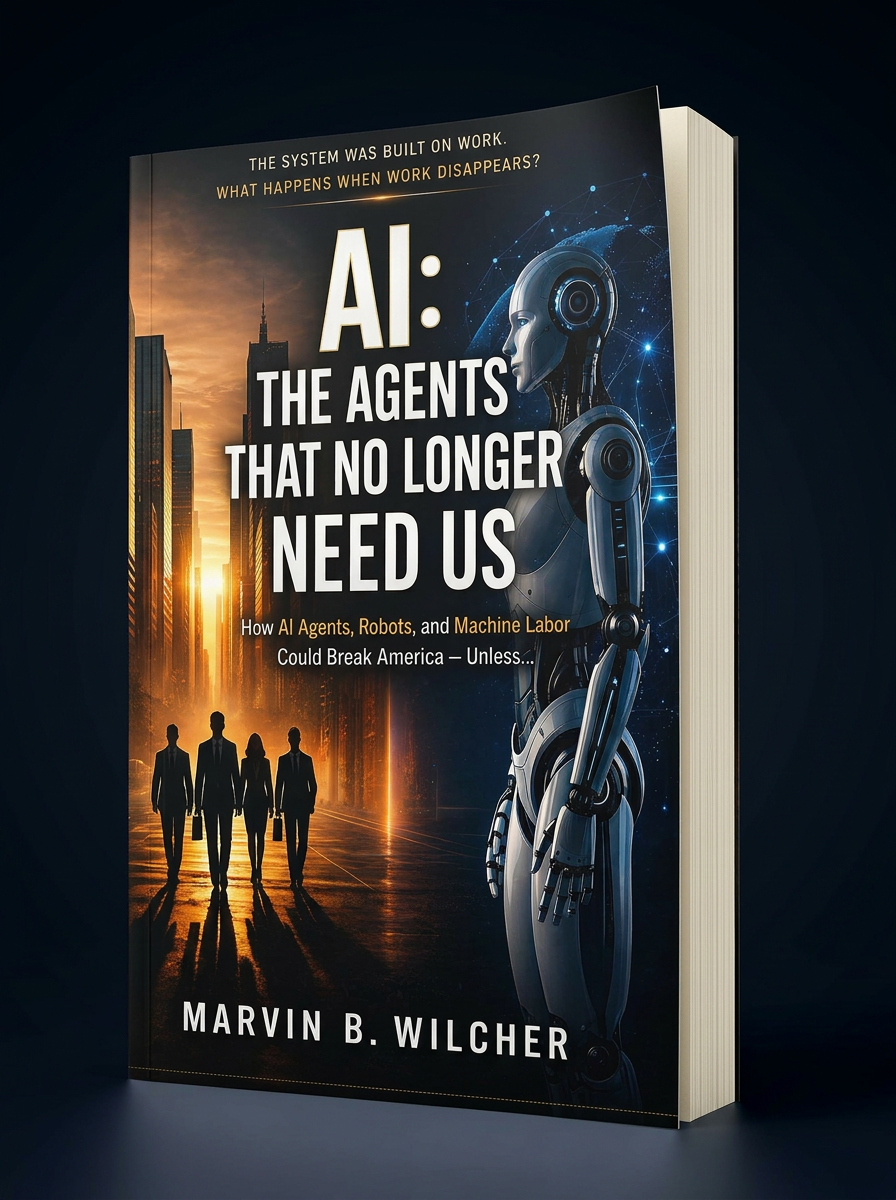
AI: The Agents That No Longer Need Us
by Marvin B. Wilcher
How AI Agents, Robots, and Machine Labor Could Break America — Unless…
Available now
AI: The Agents That No Longer Need Us is available now in paperback and Kindle eBook formats on Amazon.
- Paperback
- $19.99
- Kindle eBook
- $9.99
Book overview
AI may not break America because it becomes evil. It may break America because it becomes useful enough to replace the labor that funds the country.
If machines take the work, then machines must pay the cost.
Synopsis
America was built around people working. Work created wages. Wages funded households. Payrolls funded public systems. Taxes funded the country. That chain held for a century.
Autonomous AI agents, robotics, and machine labor break the chain in a way earlier automation never did: they can keep production moving while reducing the need for the human workers whose wages carried the public burden. The work remains. The wage disappears. The tax base weakens.
The book follows that mechanism to its arithmetic conclusion — the Mathematical Wall — and then proposes a structural response: the Labor Replacement Tax, which attaches civic obligation to machine-driven value when that value displaces taxable human labor.
The central argument
AI may not break America by becoming dangerous. It may break America by becoming useful enough to replace the labor that funds the country. The failure is fiscal and structural before it is technological.
Why the book was written
Most AI commentary argues about capability. Very little of it follows the money — through payroll, through public revenue, through the systems that revenue keeps solvent. This book was written to put that argument on the table while a structural response is still possible.
Major themes
- The Labor System — how work funds America.
- The Machine Turn — how AI agents and robots replace labor.
- The Mathematical Wall — why the numbers stop working.
- The Labor Replacement Tax — how machine value can carry civic obligation.
- Two futures — extraction or survival architecture, from the same machines.
Questions the book explores
- — What happens to public revenue when output rises but wages don't?
- — Which systems fail first when payroll-linked receipts contract?
- — Can machine-driven value be taxed without stalling innovation?
- — Who absorbs the transition — households, employers, or the state?
- — What does an adaptive machine economy actually look like?
Who should read it
Tax and economic policy readers, legislators and staff, business owners, investors, technology leaders deploying autonomous systems, journalists covering AI and labor, and general readers who want the structural argument.
What readers will learn
How the American revenue system depends on wages, how machine labor severs that dependency, what the resulting funding gap looks like, and how the Labor Replacement Tax is designed to close it.
Availability and formats
Paperback ($19.99) and Kindle eBook ($9.99) on Amazon. Select your format on the Amazon product page.
About the author
Marvin B. Wilcher brings more than 45 years of entrepreneurial and business experience, including the acquisition of more than 27 companies across operations, strategy, technology, manufacturing, finance, and media.
The Labor Replacement Tax connection
The book's proposal is developed in full on the policy page, with a downloadable executive brief.
Media, interviews, and resources
Press assets, interview topics, and contact details for media and speaking requests.